

Understanding Samsung’s 2026 Smartphone Strategy
Samsung’s 2026 roadmap represents a carefully orchestrated product calendar designed to maintain market momentum across multiple price segments. The year begins with flagship S-series announcements, continues with mid-range A-series acceleration, and culminates with innovative foldable releases. This guide provides confirmed launch windows, expected specifications, and strategic context to help buyers plan purchases around Samsung’s actual release schedule rather than speculation.
Important Note: This roadmap distinguishes clearly between officially announced products (Samsung Galaxy Z TriFold), products with credible launch windows backed by multiple industry sources (Galaxy S26 series in late January/February 2026), and products expected based on Samsung’s historical patterns (Galaxy Z Fold8/Flip8 in mid-2026). Price estimates reflect component cost pressures reported by supply chain analysts and Korean business media.

Q1 2026: Flagship Season and Strategic Schedule Changes
Galaxy S26 Series: Late January Announcement, February Sales
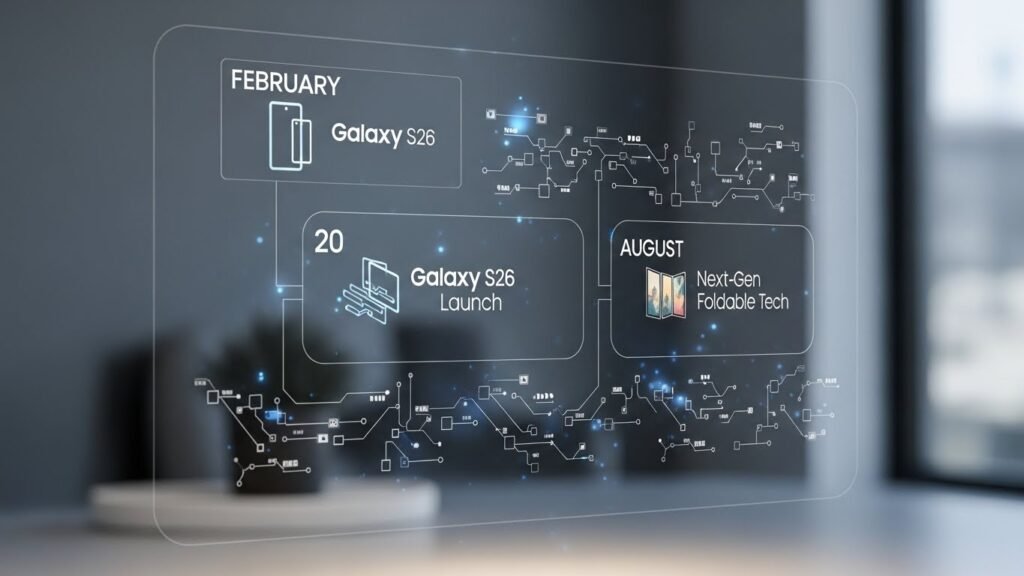
Samsung’s Galaxy S26 lineup faced internal reshuffling that nearly pushed the launch into March 2026, but the company resolved hardware verification issues and confirmed a late January 2026 announcement with February sales availability.[136][139][141] The delay stemmed from a last-minute strategic reversal: Samsung initially planned to replace the S26 Plus with a new “S26 Edge” variant, but poor sales performance of the Galaxy S25 Edge forced the company to cancel the Edge model entirely and reinstate the Plus variant.[136][138]
This lineup adjustment extended hardware testing cycles, but Korean business publication ChosunBiz confirmed Samsung had resolved these issues, allowing the company to maintain its traditional early-year flagship cadence.[136] Market availability is expected to begin in early-to-mid February 2026, following a typical 2-3 week pre-order window.[142][145]
Galaxy S26 Lineup and Regional Chipset Strategy
Samsung’s 2026 flagship strategy involves a carefully managed regional chipset split driven by manufacturing constraints and contractual obligations. The Galaxy S26 Ultra will feature Qualcomm’s Snapdragon 8 Elite Gen 5 processor globally, confirmed through FCC certification documents that identified the SM8850 chipset in both international (SM-S948B) and US carrier-locked (SM-S948U) model variants.[156]
The base Galaxy S26 and S26 Plus models present a more complex picture. Multiple industry reports indicate these devices will use Snapdragon 8 Elite Gen 5 in most global markets—including the United States, China, Japan, and Europe—while South Korea receives an Exynos 2600 variant exclusively.[158][164][167] This limited Exynos deployment reflects three interrelated constraints: low production yields at Samsung Foundry’s 3nm process node, a contractual requirement with Qualcomm mandating that 75% of Galaxy S-series devices use Snapdragon chipsets, and the strategic decision to reserve limited Exynos 2600 inventory for the domestic market.[158][167]
| Model | Global Chipset | South Korea Chipset | Key Specifications | Expected Starting Price (USD) |
|---|---|---|---|---|
| Galaxy S26 | Snapdragon 8 Elite Gen 5 | Exynos 2600 | 6.3″ 120Hz AMOLED, 4,300mAh, 25W charging, 50MP main camera[168] | $799 (estimated, may increase)[213][220] |
| Galaxy S26 Plus | Snapdragon 8 Elite Gen 5 | Exynos 2600 | Larger display, enhanced battery capacity vs. base model | $999 (estimated, may increase)[213][220] |
| Galaxy S26 Ultra | Snapdragon 8 Elite Gen 5 | Snapdragon 8 Elite Gen 5 | 6.9″ 120Hz AMOLED, 5,000mAh, 60W charging, 200MP main camera[162][176][179] | $1,299-$1,399 (price increase likely)[215][220][223] |
Galaxy S26 Ultra: Confirmed Specifications and Upgrades
The Galaxy S26 Ultra emerges as the most comprehensively documented 2026 Samsung device, with specifications confirmed through regulatory filings, supply chain leaks, and software builds discovered on Samsung’s firmware servers. The device will ship with One UI 8.5 based on Android 16, representing the first official confirmation of the One UI 8.5 version number.[178]
Display specifications center on a 6.9-inch Dynamic LTPO AMOLED panel with 120Hz refresh rate, 1440×3120 pixel resolution (approximately 498 PPI), and peak brightness reaching 2,600 nits.[162][177][179] The screen features Corning Gorilla Armor 2 protection with anti-reflective coating, continuing Samsung’s focus on outdoor visibility improvements.[177][179]
Camera hardware represents an area of conflicting reports. Multiple leakers claimed Samsung would adopt a larger Sony-made 200MP sensor (1/1.1-inch physical size), marking a significant upgrade from the 1/1.3-inch ISOCELL HP2 sensor used since the Galaxy S23 Ultra.[157][160] However, Samsung camera expert Ice Universe subsequently contradicted these claims, stating the S26 Ultra will retain the ISOCELL HP2 sensor but pair it with a wider aperture lens.[163][166] This wider aperture should enable faster shutter speeds, reduced motion blur, and improved low-light performance without changing the underlying sensor technology.[166]
The complete rear camera system includes the 200MP main sensor, a 50MP periscope telephoto camera with 5x optical zoom, a 50MP ultrawide camera, and a 10MP telephoto with 3x optical zoom.[162][179] The front camera remains a 12MP unit.[162]
Battery and charging specifications represent clear upgrades. Samsung will equip the S26 Ultra with a 5,000mAh battery paired with 60W wired fast charging—a substantial increase from the 45W charging standard maintained across recent Ultra models.[176][180][182] The device also supports Qi2 wireless charging at 15W and reverse wireless charging at 4.5W.[179] China’s 3C certification authority confirmed the 60W charging specification in December 2025, lending regulatory credibility to earlier leaks.[180]
Memory configurations span 12GB or 16GB of LPDDR5X RAM paired with 256GB, 512GB, or 1TB of UFS 4.0 storage.[162][179] Samsung will not offer microSD expansion, continuing its premium flagship storage strategy.[162]
Pricing Pressure and Pre-Order Changes
Industry analysts and Korean business publications consistently report that Samsung faces significant pricing pressure for the Galaxy S26 series due to rising component costs, particularly for RAM chips and advanced processors.[215][220][223] Multiple sources suggest the Galaxy S26 Ultra could see price increases between $100-$200 over the Galaxy S25 Ultra’s $1,299 starting price, potentially positioning the base model at $1,399.[220][223]
Compounding pricing concerns, leaker @kro_roe claimed Samsung plans to eliminate the popular “double storage” pre-order promotion that allowed buyers to purchase higher storage configurations at the base model price.[222] This change, if confirmed, would effectively increase the total cost of ownership for buyers who previously relied on pre-order incentives to obtain 512GB or 1TB models.[217][222]
Mid-Range Acceleration: Galaxy A37 and A57 in February 2026
Samsung accelerated its mid-range Galaxy A-series launch schedule to February 2026—earlier than the traditional March/April window—to maintain market momentum during the delayed flagship rollout.[138] The Galaxy A37 and A57 represent Samsung’s strategic response to filling the product gap created by the S26 series adjustments.[138]
Both devices will ship with Android 16 out of the box, making them among the first non-flagship Samsung phones to launch with the latest Android version.[138][196] The Galaxy A57 will feature Samsung’s new Exynos 1680 processor paired with the Xclipse 550 GPU, while the A37 uses the Exynos 1480 chip with Xclipse 530 GPU—the same processor used in the Galaxy A56, F56, and M56.[138][196]
Camera specifications for both models show meaningful upgrades. The Galaxy A57 will include a 50MP Sony IMX906 main camera (1/1.56-inch sensor size), a 13MP ISOCELL S5K3L6 ultrawide camera, and a 5MP macro lens.[193][199] The Galaxy A37 features an identical 50MP Sony IMX906 main camera, representing a significant sensor size increase over the Galaxy A36’s 1/1.96-inch sensor, which should improve low-light performance and reduce motion blur.[199] However, the A37’s secondary cameras remain more basic: an 8MP ultrawide and 5MP macro unit.[193][199]
Leaked specifications indicate the Galaxy A57 will adopt a flexible OLED panel and support 45W fast charging, bringing premium features down to Samsung’s mid-range tier.[202]
Galaxy Z TriFold: Q1 2026 US Launch Confirmed
Samsung officially announced the Galaxy Z TriFold in December 2025, confirming a Korean launch on December 12, 2025, followed by availability in China, Taiwan, Singapore, and the UAE.[194][200][203] The company explicitly confirmed a US launch window of Q1 2026 (January through March), though the specific date remains unannounced.[200][203]
The TriFold represents Samsung’s entry into multi-folding smartphone technology, featuring two hinges that allow the device to unfold into a 10-inch tablet-sized display.[194] The phone weighs 309 grams—substantially heavier than the Galaxy Z Fold7’s 215 grams—and runs Android 16 out of the box.[200] Samsung equipped the device with IP48 dust and water resistance and the company’s largest battery capacity among premium models, with ultra-fast charging that reaches 50% capacity in 30 minutes.[200][209]
The device launches exclusively in “Crafted Black” color, and industry analysts estimate pricing between $2,500 and $3,000 based on supply chain cost analysis.[200] Samsung plans limited initial distribution through select retail stores in each launch country to provide hands-on discovery experiences.[203][212]
Mid-2026: Foldable Evolution with Fold8 and Flip8
Expected Launch Window: July-August 2026
Samsung’s book-style Galaxy Z Fold8 and clamshell Galaxy Z Flip8 are expected to follow the company’s established mid-year foldable launch pattern, likely arriving in July or August 2026.[152][216] While Samsung has not officially announced these devices, the timing aligns with five consecutive years of mid-summer foldable unveilings at Samsung Unpacked events.
Design Philosophy Shift: Weight Reduction Over Extreme Thinness
Korean media outlet The Bell reported that Samsung’s 2026 foldable strategy prioritizes weight reduction over additional thinness improvements, responding to consumer feedback about foldable “bulk” when devices are folded.[137][143] The Galaxy Z Flip8 represents the most ambitious target: reports suggest Samsung aims to reduce weight by at least 10%, potentially bringing the device to approximately 170 grams (versus the Z Flip7’s 188 grams) with a folded thickness around 12mm and unfolded thickness near 6mm.[137]
The Galaxy Z Fold8’s weight reduction appears more conservative, with reports suggesting a target of 200 grams compared to the Z Fold7’s 215 grams—a 15-gram reduction.[143] However, some reports characterizing the Z Flip8 as reaching 150 grams appear unrealistic given current materials and component densities.[143][152]
| Model | Expected Launch | Rumored Weight Target | Key Upgrade Focus | Expected Price |
|---|---|---|---|---|
| Galaxy Z Fold8 | July-August 2026 | ~200g (vs. 215g Z Fold7)[143] | 5,000mAh battery, S Pen support return, weight reduction[143][214][216] | ~$1,999 starting price[214][216] |
| Galaxy Z Flip8 | July-August 2026 | ~170g (vs. 188g Z Flip7)[137] | 10%+ weight reduction, Exynos 2600 chipset exclusive[137][146] | Price not yet estimated |
Galaxy Z Fold8: Battery Capacity Increase and S Pen Return
Multiple reports indicate Samsung plans to equip the Galaxy Z Fold8 with a 5,000mAh battery—a 600mAh increase over the Z Fold7’s 4,400mAh capacity.[143][214][216] This represents a 13.6% battery capacity boost, addressing one of the most common criticisms of Samsung’s book-style foldables: insufficient all-day endurance for power users who take advantage of the large internal display for productivity tasks.[216]
Reports also suggest Samsung will reintroduce S Pen support for the Galaxy Z Fold8 after removing stylus compatibility from the ultra-thin Z Fold7.[214] The return of S Pen functionality would restore productivity features valued by business users and creative professionals, though the implementation method (embedded stylus versus separate accessory) remains unclear.
The device is expected to feature Qualcomm’s Snapdragon 8 Elite Gen 2 processor (also marketed as Snapdragon 8 Elite Gen 5 in some regions), up to 16GB of RAM, 1TB of storage options, and a slightly larger inner display with improved peak brightness reaching 2,600 nits.[214][216] Camera hardware will likely retain the 200MP main sensor with improved image processing through software refinements.[216]
Galaxy Z Flip8: Exynos 2600 Exclusive Strategy
Korean media reports suggest Samsung plans to make the Galaxy Z Flip8 exclusive to the company’s in-house Exynos processors, continuing the strategy initiated with the Galaxy Z Flip7.[146] This decision would leverage the Exynos 2600’s reported strengths in NPU (neural processing unit) performance for on-device AI tasks while reserving Qualcomm’s more expensive Snapdragon processors for devices where gaming performance creates stronger customer differentiation—namely, the larger-screened Z Fold8.[146]
Strategic Context and Buyer Guidance
Software Support: Android 16 and One UI 8
Google officially released Android 16 in June 2025, with the operating system rolling out to supported Pixel devices and entering the Android Open Source Project (AOSP).[131] Samsung’s One UI 8, based on Android 16, began stable rollout to Galaxy S25 series devices in September 2025.[118] The Galaxy S26 series will launch with the more refined One UI 8.5—the first confirmation of this specific version number came from firmware builds discovered in December 2025.[178]
Samsung continues its industry-leading commitment to seven years of OS updates, security patches, and feature drops for flagship devices, matching Google’s Pixel support policy.[177] This extended software support directly affects the total cost of ownership and device longevity, particularly relevant given reported S26 series price increases.
When to Buy: Timing Purchase Decisions Around Samsung’s Roadmap
Buyers considering a Samsung purchase in early 2026 face a strategic decision shaped by the confirmed roadmap:
Immediate Purchase (January 2026): Galaxy S25 series devices currently benefit from promotional pricing, trade-in incentives, and retailer discounts as Samsung clears inventory ahead of S26 announcements. Buyers who prioritize value over latest-generation features should consider S25 models, particularly if reports of S26 price increases and reduced pre-order incentives prove accurate.
February 2026 Pre-Order Window: Early adopters willing to pay premium pricing for first-day access to S26 series devices should monitor Samsung’s official announcement (expected late January) for pre-order details. However, the potential elimination of double-storage promotions means buyers should carefully calculate total ownership costs rather than assuming historical incentive patterns will continue.[222]
March-June 2026 Post-Launch Period: Buyers seeking S26 series devices at more favorable pricing should wait 6-8 weeks post-launch, when initial demand stabilizes, and carrier promotions typically expand. This window also provides time for independent reviewers to assess real-world battery life, camera performance, and thermal behavior under sustained workloads.
Mid-2026 Foldable Launch: Buyers interested in foldable devices face a choice between the immediately available Z Fold7/Z Flip7 (which will likely see promotional pricing after the S26 series launches) and waiting until July-August for the Z Fold8/Z Flip8 with larger batteries and weight reductions.
Regional Considerations and Market Availability
Samsung’s 2026 roadmap reflects a globalized supply chain with region-specific strategies. The Exynos 2600’s limitation to South Korea only affects buyers in that market, while most global customers will receive Snapdragon-powered devices.[158][167] The Galaxy Z TriFold’s staggered rollout—Korea and select Asian markets in Q4 2025, US in Q1 2026—demonstrates Samsung’s approach to managing production constraints for innovative form factors requiring specialized manufacturing.
Pricing will vary significantly by region due to local taxes, import duties, currency fluctuation, and competitive positioning. The US market traditionally receives aggressive carrier subsidies and trade-in programs that reduce effective device costs substantially below manufacturer-suggested retail prices (MSRP).
Related Articles for Techarrange
Conclusion: A Roadmap Shaped by Component Costs and Strategic Adjustments
Samsung’s 2026 smartphone roadmap reveals a company navigating component cost inflation, manufacturing constraints, and internal strategic pivots while maintaining its multi-tier product strategy. The Galaxy S26 series arrives with meaningful hardware upgrades—60W charging, refined cameras, Android 16, and seven years of updates—but faces pricing pressure that may reduce the value proposition relative to predecessor models.[176][220][223]
The mid-range Galaxy A37 and A57 benefit from accelerated launch timing and genuine camera sensor upgrades, while the Galaxy Z TriFold demonstrates Samsung’s continued investment in form factor innovation despite the high costs and limited initial production volumes such devices entail.[138][193][200]
For buyers, the roadmap provides actionable planning information: flagship launches concentrate in late January through February, mid-range options arrive in February, and foldable upgrades follow historical mid-year patterns. The most strategic purchase decisions will weigh immediate needs against confirmed launch timing, evaluate total ownership costs including potential price increases and changing incentive structures, and align device capabilities with actual usage patterns rather than specification sheet peaks.